At some point, we’ve all wondered walk it would be like to go back in time and see the world as it once was before vast forests were hewn and the land carved up into roads and house lots and covered on concrete and steel. It would look quite different, but more so than you might think. The boundless forests of eastern North America hardly resembled even the most pristine remnants that persist in our national forests and parks.
Hiking along what would one day become the Appalachian Trail might seem quite strange and foreign. Mighty oaks that now dominate the landscape would be fewer and farther between. Scarcer still would be lone white pines, towering straight and tall, many stories high, waiting to perhaps to one day be felled and carried to the coast and carved into a ship’s mast. The dominant tree in the eastern hardwood forest was the American chestnut.
Before European settlers arrived and for a long time after, chestnuts were an important source of hard mast for deer, bear, turkeys and a host of other wildlife. After settlement, they became economically important, particularly to people of the southern Appalachians. Their mast was gathered by the bushel. Some was brought home, and the rest sold, all for human consumption. Their wood – lightweight, soft, easy to split, resistant to decay and warping or shrinking – was ideal for posts, poles, pilings, railroad ties and split-rail fences. Its straight grain also made it desirable for building log cabins, furniture and caskets. The leather industry used even the tannin extracted from its bark for tanning. Yet in the geologic blink of an eye, they would all be gone … almost all.
In the early 1900s, a blight was introduced into the United States, most likely from Asian chestnut trees imported as nursery stock. Over the next 30 years, it spread from Maine to Georgia, decimating an estimated 30 million acres of trees. By the Great Depression, the most common hardwood tree in eastern North America had been all but wiped out.
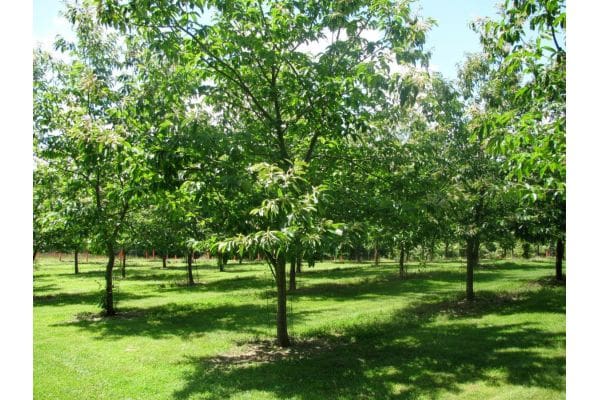
Like a germinating nut, hope springs eternal, and a few dedicated botanists held out hope that one day chestnuts might return to the eastern forest. One such individual was Dr. Robert T. Dunstan, a well-known plant breeder in Greensboro, N.C. A friend of Dunstan’s – James Carpentar, discovered a large living American chestnut in a grove of dead and dying trees in Ohio. Carpentar sent Dunstan some budwood, which he then grafted onto chestnut rootstock and cross-pollinated with specially selected Asian varieties. As the new stock gradually grew and bore fruit, Dunstan selected individuals with the best hybrid characteristics, crossing them back to both the American and Chinese parent trees until he developed a superior variety – the Dunstan Chestnut.