
Hunting and Fishing News Blog Articles

Stay up-to-date on hunting, fishing and camping products, trends and news.

Montana Region 7 Deer Populations Cut In Half

Photo courtesy of Joetography

The Montana deer population survey numbers for 2022 were published late last year and show that mule deer numbers are down, way down! There are a lot of factors to blame, starting with the largest culprit that has been proven by research in many Western states and that is drought. Research shows deer (does) that go into winter in poor shape, with minimal body fat in dry years, have much lower fawn health and birth rates in the spring of the next year. 2020-2022 were very dry years in the eastern half of the state and forage in the fall of 2021 was especially poor when I hunted there. Trophy quality also seemed to be hurt by the drought. In 2022 population counts showed 58,000 mule deer in Region 7 which is down from 114,000 in 2020; that’s a 52% decrease!

Disease is also another factor and sure doesn’t help the situation; EHD, Blue Tongue, and CWD. All of these diseases have affected the eastern half of the state the last few years. CWD has been the one in the spotlight recently but there’s no proof that CWD has wiped out entire herds of deer in the West unless you consider how it has impacted state’s like Montana’s deer management policies. 

Overhunting could also be a factor. Montana gained a lot of residents the last two years and if you don’t know, Montana is an opportunity state and is not managed for trophies. It’s managed for opportunity, hence the many general tag areas. Basically Montana is a, “If it’s brown, it’s down” kind of state and all of Regions 6 and 7 are either-sex, either species except for one district on the general tag. In addition there are thousands of antlerless tags available for each species in these regions as well.

For more in depth insight, my expert analysis and hunt recommendations for the entire state of Montana consider joining Eastmans’ TagHub.

The post Montana Region 7 Deer Populations Cut In Half appeared first on Eastmans' Official Blog | Mule Deer, Antelope, Elk Hunting and Bowhunting Magazine | Eastmans' Hunting Journals.

Copyright

© Eastmans

10 Most Common Big Game Violations Part 6 – Shooting From/Across Roadway and Party Hunting (Transfer Tag)

Photo courtesy of USFWS National Digital LibraryShooting from or across a public roadway or right of way Misdemeanor: Up to $1,000 fine, 0-6 months in jail, 0-3 years license revocationIdaho Code 36-1508(a) states “No person shall: Shoot from Public Highway. Discharge any firearm from or across a public highway…”Idaho Code 36-202(x) states: “Public highway means the traveled portion of, and the shoulders on each side of, any road maintained by any governmental entity for public travel, and includes all bridges, culverts, overpasses, fills, and other structures within the limits of the right-of-way of any such road.”Idaho Administrative Rule 13.01.08.010.01 states “Established Roadway. Any road established, built, maintained, approved or designated by any governmental entity or private landowner for travel by full-sized automobiles. An established roadway shows evidence of repeated use by full-sized automobiles, and may include a traveled way of natural earth with depressed wheel tracks and little or no vegetation in the wheel tracks.”

This one is pretty simple and most states also have similar laws.  Don’t shoot from or across a roadway.  I think of the roadway as anything maintained by any government agency for use by full-size vehicles.  This would not include, in my opinion, OHV (Off Highway Vehicle) trails.  Idaho has a lot of 50 -inch and motorcycle only trails that are called “trails” for a reason.  If it’s called a “trail” you’d be safe but it’s called a “road” I wouldn’t test it.  Bottom line is, get off the road and don’t shoot across it.

Transfer of Tag/License to AnotherMisdemeanor: Up to $1,000 fine, 0-6 months in jail, 0-3 years license revocationMandatory 1 year license revocationIdaho Code 36-409(c) states “The appropriate tag must be had for the hunting or taking of each and every one of the aforementioned wildlife…i.e. moose, bighorn sheep, mountain goat, elk, deer, antelope, mountain lion, black bear, grizzly bear, wolf, sandhill crane, swan, sage grouse, or turkey”Idaho Code 36-202(j) states “”Hunting” means chasing, driving, flushing, attracting, pursuing, worrying, following after or on the trail of, shooting at, stalking, or lying in wait for, any wildlife whether or not such wildlife is then or subsequently captured, killed, taken, or wounded”

This is another simple one.  If you don’t have a tag for the animal, don’t shoot it.  This one is common for large groups of hunters (Parties).  There will be a large group that go out hunting together and shoot deer as they see them until everyone’s tag is filled, even though only a select few have a tag.  This is also common when people get tags that have no intention of actually hunting.  For example, Grandma gets a tag and someone else “fills” her tag for her.  If you don’t have a tag for that animal, don’t shoot it.  Tags are issued to specific people for a reason.  

The post 10 Most Common Big Game Violations Part 6 – Shooting From/Across Roadway and Party Hunting (Transfer Tag) appeared first on Eastmans' Official Blog | Mule Deer, Antelope, Elk Hunting and Bowhunting Magazine | Eastmans' Hunting Journals.

Copyright

© Eastmans

Utah Shed Hunting Closed… It’s About Time!

Photo Courtesy USFWS National Digital Library

Utah recently closed down all shed antler hunting through April 30. The only question rattling around in my largely empty skull is, “What took so long?” 

Ungulate populations across southern Wyoming and northern Utah and Colorado are severely struggling this winter. I just passed through the Park City to SLC corridor last week and witnessed deer and elk eeking out a difficult existence firsthand. The conditions were even worse along the I-80 corridor in southern Wyoming. There is no reason to be pushing those animals around in the winter, especially one like this and for something as trivial as picking up antlers.  

I enjoy “hunting” for shed antlers as much as anyone. It’s a great excuse to get outside with family and friends and get some exercise. That said, I feel like it’s past time that some major regulation be put in place on the practice. Too many people pushing around too many weak and struggling deer, and to a lesser extent elk, are damaging a dwindling western icon, mule deer. It’s way past time we put the deer first and our own selfish desires for “brown gold” second. 

I’m not saying we can’t pick up antlers, we should, and we should enjoy doing it but we need to be doing it at a time when the deer especially, have moved or have access to better groceries and are out of the brutal grasp of old man winter. I’m thinking mid-May or early June. Let’s put the deer first and the lust for antlers second. We owe it to them.

What’s your take? 

Continue reading

Copyright

© Eastmans

We Were Wrong! The Changing Face of Bear Hunting

I haven’t found one yet, but I’ve heard there are recipes for eating crow. I wish I could find a good recipe because I’ve been eating my fair share of it lately.

Every year during legislative sessions we hear of bills that come up that make us raise our eyebrows. This year has been no exception.

Recently a bill to change the classification of bear in Wyoming from a trophy game animal to a large carnivore game animal was sent to us and here was my response before understanding what the bill was about:

I’m 100% against this BS. Hunters giving way to the anti’s in this leads to them pushing for more and more and more until eventually it is outlawed in the state just like Washington.

😉
Continue reading

Copyright

© Eastmans

2023 Arizona Elk Application Strategy

Arizona has a big game draw process whose complexity rivals the trophy quality of its elk tags. If you are familiar with how the AZ system works, read on, for those who are new to applying in AZ or who haven’t read up on it in a while, scroll to the bottom for some basic information on how it all works.

The Basics

Applications are due by 11:59 on February 14, 2023Applications must be submitted online @ https://draw.azgfd.com/All applicants must have a hunting license valid through the draw application deadline.Arizona requires all applicants to enter credit card information at the time of application, but only the application fee is paid at that time. The remaining cost is only charged to the card if a tag is drawn.Application fees are $13 for residents and $15 for non-residents.Bonus points can be purchased for the same cost as an application fee and are only available during the draw application period.For a full breakdown of the draw process visit the AZGFD website: https://www.azgfd.com/hunting/draw/process/

Strategies

For those of you with your heart set on hunting blue chip units in the rut I will keep this very simple. There are a handful of units in AZ that consistently produce top end bulls; 1, 3C, 9, 10, 23(North and South) and 27.  All of these are exceptional elk units with high densities and solid age class. Hunting any of these units in September is truly the experience of a lifetime and it will likely take a lifetime to draw one. Archery hunts in any of these units will require double digit bonus points and a firearm hunt will require somewhere in the upper 20’s to draw.

Continue reading

Copyright

© Eastmans

10 Most Common Big Game Violations Part 5 Proxy Statement

Photo Courtesy of Rodger HolscherPossess/Transport wildlife without a Proxy Statement – Idaho 36-502(a)(4)Misdemeanor: Up to $1,000 fine, 0-6 months in jail, 0-3 years license revocationIdaho Code 36-502(a)(4) states “No person shall give another person wildlife to possess or transport unless they also give the transporter a proxy statement…”. “Possess” is both actual and constructive possession – Idaho Code 36-202(m)“Transport” is carrying or conveying (or causing to be carried or conveyed) from one place to another – Idaho Code 36-202(r) 

The word “Proxy” means the authority to represent someone else.  A Proxy Statement is a small form that is attached to your printed out tag.  This form has the tag number and tag holder’s information at the top.  The tag holder info will include the name and address of the tag holder along with the hunting license number.  Towards the bottom of the proxy statement, there’s a section for sex of the animal, date harvested and signature of the hunter.  The Proxy Statement requires a pen to fill in a bubble for sex of the animal, fill out the date harvested and for you or the tag holder to sign. 

After examining this section and its definitions, I’ll give you a few scenarios for when you should be filling out a Proxy Statement per the “letter of the law”.

You are a few miles in the backcountry on an elk hunt with a buddy, you kill an elk and your buddy volunteers to help pack out the elk.  Per this law, you would need to fill out a “Proxy Statement” for your buddy to possess and transport your animal or parts thereof.   Seems a little on the ridiculous side if you ask me.  Even more on the ridiculous side is if your 14-year-old daughter killed her first deer, you’d need a Proxy Statement to help her pack out her deer.  

I don’t mean for this to scare people but it’s what the law says and it CAN be enforced strictly.  On the other hand, you have the “spirit of the law”.  I have spoken with an Idaho game warden that I trust and he gave me his view on this law.  He has seen this law used in multiple different ways so I’ll give you the common scenarios where he has enforced this code.  

If you are transporting wildlife for another person and lose sight of that person, especially if you make it back to camp or the truck before they do, you need to fill out a Proxy Statement.  If you transport the wildlife on the roadway without the tag holder with you, you need a Proxy Statement.  If you are a parent and you are taking your kid’s meat to a game processor, and that successful hunter is not with you, you need a Proxy Statement.  

Continue reading

Copyright

© Eastmans

Will The G-Bear Be Delisted…Finally?

Folks paying attention to the ongoing saga of delisting the grizzly bear finally woke up to long-awaited response on the morning of February 3rd. The U.S. Fish and Wildlife Service announced their take on petitions for delisting that were submitted by Montana, Wyoming, and Idaho.

While the 90-day findings the federal government issued were nearly a year in the making, there was good news for two of the states who petitioned for the bear to come off the list. Montana and Wyoming were given the green light to begin the 12-month review.

This is the third time the grizzly bear in Wyoming and Montana has entered in the 12-month review process; first in 2007 and then again in 2017.

One difference is these delistings are based on smaller recovery zones – that means the bears in certain areas can be delisted but the grizzly bear as a whole in the Lower-48 area would not. In addition to Yellowstone bears, Montana also has been given the go-ahead to review the Northern Continental Divide population of grizzlies for delisting. Those bears, commonly encountered in the famed Bob Marshall Wilderness and west, are seen as a distinct, healthy population above recovery objectives, as well.

Continue reading

Copyright

© Eastmans

Washington State Hunters Fire Back at Commission

Past readers of this blog recall that in 2022 the WDFW commission cancelled the annual spring bear hunt in Washington, claiming lack of scientific evidence for the hunt, despite 48 years of data and the elk population being significantly below target.  The main reason for the cancellation of this hunt has to do with the commissioners that our governor has appointed, the majority of which are anti-hunting.  With these individuals controlling the commission, the outlook for hunting in Washington is not good. With spring bear off the table, many hunters are asking what species are next?

During 2022, a Washington hunting and conservation group took the steps to sue Governor Jay Inslee for failing to follow the Washington code which clearly states that governors “shall seek to maintain a balance reflecting all aspects of fish and wildlife, including representation recommended by organized groups representing sportfishers, commercial fishers, hunters, private landowners, and environmentalists.”

The governor’s appointments to the commission have not been balanced, nor included representation among all those groups.  He has appointed 5 commissioners over the course of 2021 and 2022 who are all voting along anti-hunting lines.  This is why we are seeing this seismic shift in how wildlife is being managed in Washington recently.  What is even more scary is that there are two commissioners whose positions are up soon, one of which belongs to the most pro-hunting commissioner left.  

These new commissioners are not all that interested in solving or addressing the significant decline in the elk population in the Blue Mountains, even though the department’s own data clearly shows that predation is a significant factor.  They are content to watch our big game herds shrink as long as the hunting of predator animals does not occur.  

Continue reading

Copyright

© Eastmans

10 Most Common Big Game Violations Part 4 (Tagging)


Failure to properly validate and attach the tag. Misdemeanor: Up to $1,000 fine, 0-6 months in jail, 0-3 years license revocation. Idaho Code 36-409(d)Idaho Administrative Code 13.01.08.320 https://adminrules.idaho.gov/rules/current/13/130108.pdf 

In Idaho, it is a misdemeanor to not properly validate and attach your tag immediately upon kill.  I’ll be breaking this down, so you have a better understanding of what exactly is required.  

In Idaho Statute 36-409(d) “Game Tag to Be Validated and Attached to Carcass” it states, as soon as a person kills any wildlife for which a tag is required, that tag must be validated and attached in a manner provided by commission rule.  That law can be vague, so we must look to the Idaho Administrative Code 13.01.08.320.  Here we can find a more descriptive answer.  

Immediately after any deer, elk, pronghorn, moose, bighorn sheep, mountain goat, mountain lion, black bear, grizzly bear, or gray wolf is killed, the appropriate big game animal tag must be validated and securely attached to the animal.

Continue reading

Copyright

© Eastmans

Jury Convicts Muzzleloader Who Shot & Killed an Archery Hunter

Yesterday, Ronald J. Morosko was found guilty of criminally negligent homicide in the death of Gregory Gabrisch during a fatal hunting incident.  Mr. Morosko, while muzzleloader hunting on Sept. 17, 2021, fatally shot Gabrisch (an archery hunter). The incident occurred in the Lizard Head Wilderness Area of Dolores County, Colorado. The shooting occurred as both men hunted elk during overlapping muzzleloading and archery seasons. The men were hunting separately, and Morosko believed he was shooting at an elk when he hit and killed Gabrisch. 

Morosko is currently free on bond until a sentencing hearing set for March 31. The sentence for criminally negligent homicide, a Class 5 felony, is one to three years in prison, or probation which can include up to 90 days in jail. Additionally, a fine of up to $100,000 may be imposed.

Chief Judge Todd Plewe presided over the case. During the trial, the prosecution argued “Morosko failed to perceive the substantial danger in the woods, that other hunters are in it, doing the same thing, trying to call in elk.” Morosko violated hunting rules because “he did not identify his target.”

Defense attorneys argued the incident was a “horrible tragedy” but did not meet the legal standard of negligence. They added the overlap of archery and muzzleloader seasons and the fact that blaze orange clothing was not required for bowhunters was “senseless” and probably contributed to the accident.

Continue reading

Copyright

© Eastmans

Giant Mouse Knife Giveaway

.rafflepress-giveaway-iframe-wrapper iframe { width: 1px; min-width: 100%; *width: 100%; height: 1000px; }.rafflepress_iframe_loading { background-image: url('data:image/gif;base64,R0lGODlhEAAQAPIAAP///wAAAMLCwkJCQgAAAGJiYoKCgpKSkiH/C05FVFNDQVBFMi4wAwEAAAAh/hpDcmVhdGVkIHdpdGggYWpheGxvYWQuaW5mbwAh+QQJCgAAACwAAAAAEAAQAAADMwi63P4wyklrE2MIOggZnAdOmGYJRbExwroUmcG2LmDEwnHQLVsYOd2mBzkYDAdKa+dIAAAh+QQJCgAAACwAAAAAEAAQAAADNAi63P5OjCEgG4QMu7DmikRxQlFUYDEZIGBMRVsaqHwctXXf7WEYB4Ag1xjihkMZsiUkKhIAIfkECQoAAAAsAAAAABAAEAAAAzYIujIjK8pByJDMlFYvBoVjHA70GU7xSUJhmKtwHPAKzLO9HMaoKwJZ7Rf8AYPDDzKpZBqfvwQAIfkECQoAAAAsAAAAABAAEAAAAzMIumIlK8oyhpHsnFZfhYumCYUhDAQxRIdhHBGqRoKw0R8DYlJd8z0fMDgsGo/IpHI5TAAAIfkECQoAAAAsAAAAABAAEAAAAzIIunInK0rnZBTwGPNMgQwmdsNgXGJUlIWEuR5oWUIpz8pAEAMe6TwfwyYsGo/IpFKSAAAh+QQJCgAAACwAAAAAEAAQAAADMwi6IMKQORfjdOe82p4wGccc4CEuQradylesojEMBgsUc2G7sDX3lQGBMLAJibufbSlKAAAh+QQJCgAAACwAAAAAEAAQAAADMgi63P7wCRHZnFVdmgHu2nFwlWCI3WGc3TSWhUFGxTAUkGCbtgENBMJAEJsxgMLWzpEAACH5BAkKAAAALAAAAAAQABAAAAMyCLrc/jDKSatlQtScKdceCAjDII7HcQ4EMTCpyrCuUBjCYRgHVtqlAiB1YhiCnlsRkAAAOwAAAAAAAAAAAA==') !important; background-repeat: no-repeat !important; background-position: center 100px !important; height: 100%;}

function rafflepress_getParameterByName(name, url) { if (!url) url = window.location.href; name = name.replace(/[\[\]]/g, "\\$&"); var regex = new RegExp("[?&]" + name + "(=([^&#]*)|&|#|$)"), results = regex.exec(url); if (!results) return ""; if (!results[2]) return ""; return decodeURIComponent(results[2].replace(/\+/g, " "));}function insertIframe( ID, src, minHeight) { var wrapperID = 'rafflepress-giveaway-iframe-wrapper-'+ID; var iframe = document.createElement('iframe'); iframe.setAttribute('id', 'rafflepress-'+ID); iframe.setAttribute('class', 'rafflepress-iframe'); iframe.setAttribute('src', src); iframe.setAttribute('frameborder', '0'); iframe.setAttribute('scrolling', 'no'); iframe.setAttribute('allowtransparency', 'true'); if (minHeight) { iframe.setAttribute('style', 'min-height:'+minHeight); } iframe.setAttribute('onload', 'rafflepress_resize_iframe_'+ID+'(this)'); document.getElementById(wrapperID).appendChild(iframe);}// phpcs:disableinsertIframe( '51872677','https://blog.eastmans.com/?rafflepress_page=rafflepress_render&rafflepress_id=16&iframe=1&giframe=false&rpr=&parent_url=https%3A%2F%2Fblog.eastmans.com%2Ffeed%2F&72108&rp-email='+rafflepress_getParameterByName('rp-email',location.href)+'&rp-name='+rafflepress_getParameterByName('rp-name',location.href),'' );// phpcs:enablefunction rafflepress_resize_iframe_51872677(){ iFrameResize({ log: false, onMessage: function(messageData) { if (messageData.message == 'rafflepress_loaded') { var el = document.getElementById('rafflepress-giveaway-iframe-wrapper-51872677'); var className = "rafflepress_iframe_loading"; if (el.classList) el.classList.remove(className); else el.className = el.className.replace(new RegExp('(^|\\b)' + className.split(' ').join('|') + '(\\b|$)', 'gi'), ' '); } } }, '#rafflepress-51872677');};

The post Giant Mouse Knife Giveaway appeared first on Eastmans' Official Blog | Mule Deer, Antelope, Elk Hunting and Bowhunting Magazine | Eastmans' Hunting Journals.

Copyright

© Eastmans

Broncos Finally Score

Image from Derek’s Instagram Account

After a tough season when it seemed like the Broncos new multi-million-dollar quarterback had difficulty scoring, retired Denver Broncos defensive lineman and Super Bowl champion Derek Wolfe did score by killing a huge 200-pound, 8.5-foot mountain lion… and he did it with a bow. The giant cat had been “wreaking havoc” and killing pets in a residential area. 

Derek received a call from a friend, and he offered to help.

When they got to the area frequented by the cat, they found a full-grown, mule deer that had been killed and dragged across the road, right across the street from somebody’s house. Then they followed those tracks up to a house and discovered the lion had been living beneath a woman’s porch.

Continue reading

Copyright

© Eastmans

10 Most Common Big Game Violations Part 3 (Permits)

Hunting without an appropriate permit (i.e., Archery/Muzzleloader Permit) 

(Idaho Code 36-409 (e)/(f) (Infraction $136)

Idaho requires you to purchase and carry an Archery or Muzzleloader permit while hunting with those methods of take, in certain seasons.  Below is a breakdown of situations when you would need those permits and how to obtain them in Idaho.  Review your own state’s requirements because they all handle them differently.  For instance, Montana requires an Archery License, but Utah, California, Colorado and many others do not.  Alaska takes it a step further and requires the online class, Field Day class, and shooting proficiency test to be able to hunt with Archery equipment.   

In Idaho, Archers wanting to hunt in “Archery Only” designated seasons you will need to have an Archery Permit in your possession.  You are required to have an Archery permit for any “Archery Only” Controlled Tag.  Also, if you are hunting with a General Tag but during the “Archery Only” season, you will need an “Archery Permit”.  For instance, if you were archery deer hunting in Unit 59A in September during the “Archery Only” season, you will need an Archery Permit.  However, if you are archery deer hunting (with the same tag as before) in Unit 59A in October during the “Any Weapon” season, you would not need the Archery Permit.  

Continue reading

Copyright

© Eastmans

Colorado Parks and Wildlife releases Draft Colorado Wolf Restoration and Management Plan


Last month the Colorado Parks and Wildlife (CPW) staff presented the Draft Colorado Wolf Restoration and Management Plan to the CPW Commission. The Draft Colorado Wolf Restoration and Management Plan is now available for public review. The CPW Commission will discuss and take feedback from the public at five upcoming meetings around Colorado. The public can comment on the draft plan online and in the upcoming public meetings through February 22, by visiting engagecpw.org.

As you may know, State statute 33-2-105.8 directs the Colorado Parks and Wildlife Commission to:

Develop a plan to restore and manage gray wolves in Colorado;Take necessary steps to begin reintroduction no later than Dec. 31, 2023, on designated lands west of the Continental Divide; andPay fair compensation for livestock losses caused by gray wolves

Beginning in April 2021, CPW contracted with Keystone Policy Center to conduct the public involvement effort. CPW worked with Keystone Policy Center to hold 47 public meetings in 2021, collecting feedback from more than 3,400 Coloradans.

Continue reading

Copyright

© Eastmans

Overcrowding by Non-resident Hunters Cancels Colorado OTC Elk Hunts

Mr. Siegfried contacted Eastmans’ Hunting Journals via email regarding his opinion on what the state of Colorado is doing with OTC Archery Elk Tags. This blog is an op-ed article from a Colorado resident hunter’s perspective. We welcome responses and other opinions as well. 

Hunting is not a right in Colorado, our legislators do not promote equity in resident tag allocation like other western states.  Most western states cap non-residents at 10% of limited big game tags, Colorado gives 20-35% of limited elk and deer tags to non-residents and this does not take into effect the soft cap loopholes or landowner vouchers that are sold back to non-residents. If you read the bios of the CPW Commissioners, you won’t see many folks passionate about hunting and fishing and you will see that no one is defending resident hunters when it comes to tag allocation and OTC hunting opportunities. One of the few CPW Commissioners that is a “Sportsperson” is an outfitter named Marie Haskett, and last I checked outfitters largely represent non-residents, since that is who pays their bills.  

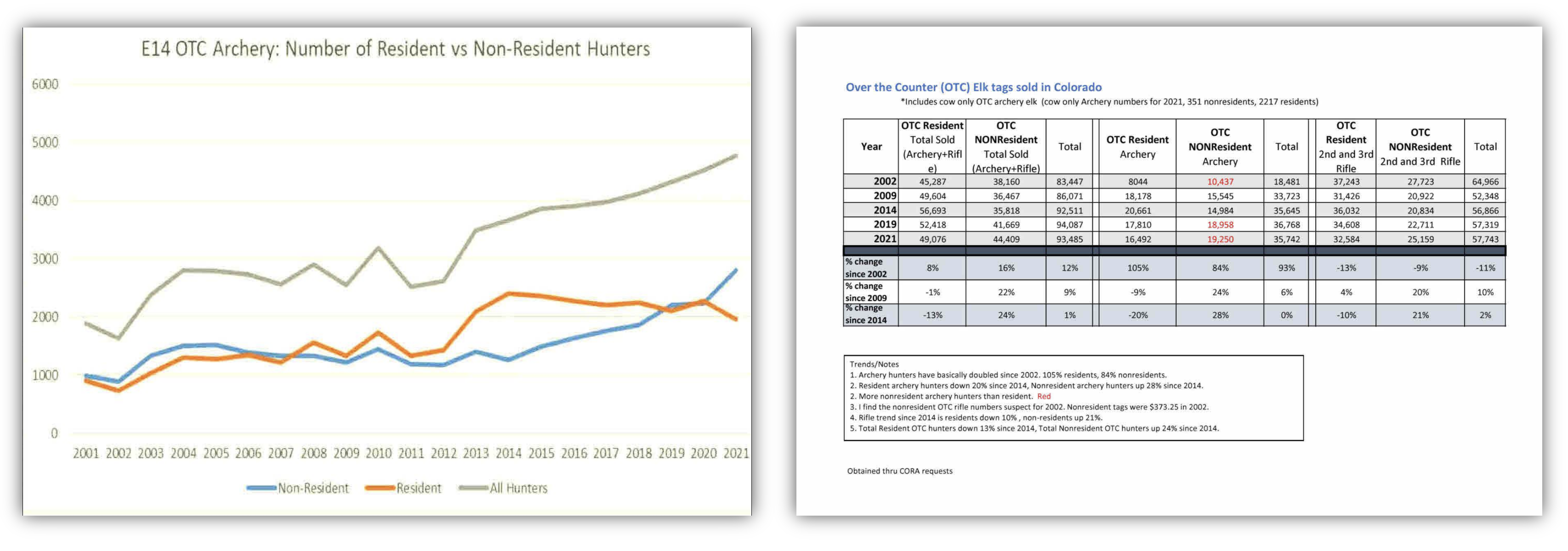
During the January 17, 2023 CPW Commission meeting a couple members of the Colorado Resident Hunter Association (Facebook Group) testified to try and save OTC archery hunting in the five E14 / Grand Mesa units (41, 52, 411, 421 and 521).  CPW was responding to overcrowding complaints over the past few years.  The attached Grand Mesa Archery CPW graph that was shared with the commission this fall shows that non-resident archery hunters are up 250% (1200 to 3000) since 2014 and that resident hunters are actually down 20% (2400 to 2000) since 2014. The surge in hunting pressure is the result of non-residents, in fact, 3 out 5 archery elk hunters on the Grand Mesa are non-residents. No state in the country has numbers like this, where residents of the state are run out of the woods by non-residents, yet that is the trend in archery OTC units and rifle OTC units across Colorado. I have submitted a couple CORA requests over the years to get the following stats. Statewide since 2014 archery OTC resident hunters are down 20% and rifle OTC resident hunters are down 10%. Meanwhile, all statewide OTC hunts (rifle + archery) in Colorado have seen an increase of over 24% by non-residents, from 35,818 in 2014 to 44,409 in 2021.  

Most western states like Wyoming, Utah and Idaho would respond to this non-resident surge by capping non-resident OTC tags and keeping OTC elk hunts open to residents to promote the sport to future generations of resident hunters. Not Colorado, on January 17th the CPW Commission with no objection to the facts, ruled to limit all archery elk tags on the Grand Mesa next year and then Commissioner Marie Haskett doubled down and proclaimed that they needed to change all archery to statewide draw in 2024 to meet biological and social management objectives. That’s right, social management objectives, I guess that does not include resident hunter equity compared to other states.

Continue reading

Copyright

© Eastmans

Colorado Kills OTC Elk Tags!

At a hybrid, in-person/virtual meeting January 17 and 18 in Colorado Springs, the Colorado Parks and Wildlife Commission kicked off discussion for the next 5-year Big Game Season Structure (we’re entering the 4th year of the current plan). They will consider shifting to a 7-year structure in the future to allow more time for changes to be studied.  Significant items discussed were:

CPW commission approved a change to remove both resident and non-resident Over-the-Counter (OTC) unlimited archery elk tags from the Grand Mesa Unit DAU E-14 (GMUs 41, 411, 42, 421, 52, 521) to assist with overcrowding (even though the vast majority of the OTC archery hunters in this area are non-residents). A few public comments were heard, and those focused on overcrowding primarily being caused by out-of-state hunters. The commission stated that at a future meeting they will consider removing ALL archery OTC licenses statewide for 2024 and converting them to draw. Dates & Lengths of Rifle Seasons;Length of breaks between seasons,4th season over Thanksgiving is not popular, may move it,Option to add Deer Tags to 1st Season,Adding a 2nd season for Antelope (especially for NE corner).Trophy Species Weighted-Point Draw Process Modification. The commission will consider methods of improving the likelihood of high-point holders to draw a sheep, goat, or moose tag. They will discuss moving to a Bonus Point system which is similar to weighted points, but simpler and already used/tested in other states.

Some significant items NOT discussed during this meeting were:

Preference pointsPreference point bankingGroup preference point averagingLicense allocation, High-Demand Hunts shifting from an 80%/20% split to 90%/10%.

 As a side-note, the Commission discussed making Hunter Reporting mandatory.

Additionally, items discussed included; modifying several Game Management Unit boundaries; annual changes to season dates; limited license areas and manner of take provisions for elk, pronghorn, moose, bear, bighorn sheep and mountain goat; annual changes to quotas for bighorn sheep and mountain goats; creating, modifying, and removing hunting seasons in multiple units for deer, elk, pronghorn, moose, bighorn sheep and mountain goat; and annual changes to season dates and harvest limits for mountain lions.

Continue reading

Copyright

© Eastmans

Grizzly Bears Test Positive for Avian Flu

Three juvenile grizzly bears have tested positive for avian flu this fall according to Montana FWP. The bears displayed a high amount of disorientation, partial blindness and appeared to be in poor bodily condition. Two were in the Augusta area and the other was near Kalispell. The bears were euthanized due to their condition.

These are the first grizzlies documented with avian flu but many other scavenging animals have also tested positive for the flu including black bears, skunks, raccoons, foxes, and a coyote. This pathogen is relatively hard to contract from normal passerby contact, but these animals are sure to be consuming birds that have died from the flu which has been a real issue all across the country in the past year. 

It is possible for this strain of avian flu to spread to humans as well but the risk is considered very low by the CDC. It is recommended to stay away from dead waterfowl or other birds that appear to be sick and that goes for your pets too. 

Source Link:

Continue reading

Copyright

© Eastmans

California MRS: Things to Watch For

Tis the Legislative Season and with that comes new laws and regulations.  California has been in the spotlight over the last few years for the Anti-Bear Hunting movement that has been happening there.  Anti-hunting NGO’s (Non-Governmental Organizations) have attempted to get bear hunting removed from California.  The removal of bear hunting has been shot down, as of now, but it’s expected to be returning to the docket again this year.  Keep an eye out for that one.  

Going on right now are the WRC (Wildlife Resource Committee) meetings.  At these meetings, new proposals are heard on regulatory actions and public comments, for or against.  The WRC then decides on whether that proposal should be heard by the Fish and Game Commission, for possible regulatory changes.  

One of these proposals that will be moving forward in the process, is the proposal to close the “Grandma Loophole” for party application draw tags.  Historically, your “Grandma” would buy a license every year and apply for a draw tag.  With that, she would gather a preference point each year she doesn’t draw a tag.  If she draws a tag and returns that tag, she will also receive a preference point.  Now say she has 10 points, and you decide to start putting in for draw hunts as a party.  In California, they average the preference points out among the party members.  Grandma having 10 points and you having no points, puts your average at 5 points.  

This year you both apply as a party for an X6A deer tag.  X6A usually takes 5 points (or 5 years of applying and being unsuccessful) minimum to draw.  With the 5 Point average, you draw the tag your first year applying.  Once you draw that tag, Grandma turns back in HER tag and gets another preference point so she will have 11 next year.  You hunt X6A this year and next year you have an even better shot because now Grandma has 11 points, bringing your party average to 5.5 points.  You can see how this snowball can start rolling down the hill and makes it easy for someone to game the system.  You could hunt X6A, or even better units, every year when others must wait years to hunt those units if you apply this way.

Continue reading

Copyright

© Eastmans

Good News for Wyoming Non-resident Hunters

Senate file 60, which would increase non-resident fees, fails in the Wyoming senate.

In a decisive 20-10 vote, the Wyoming Senate voted to kill the Senate File 60 bill that would have increased non-resident fees for deer, elk and antelope in the “special draw” by nearly double. The bill also had a last-minute amendment which would have also increased the costs of sheep, moose, goat and grizzly tags for non-resident hunters. 

After reading between the lines it looks like there was much debate on the floor regarding this bill, which surprisingly revolved around the origin of the bill not necessarily the merits of the bill itself. Some senators were skeptical that this bill could hold up to Wyoming constitutionality because it was a revenue generating and taxation bill which would need to originate from the state House instead of the Senate according to the Wyoming State Constitution. 

Although done for right now, there is still a slim possibility that this bill becomes a phoenix and rises from the ashes, this time in the state House instead of the Senate. 

Continue reading

Copyright

© Eastmans

10 Most Common Big Game Violations: Part 2

No Evidence of Sex/Species Naturally Attached (Idaho Code 36-1401(a)(2)(M) (Infraction $136)

In Idaho you are required to leave the evidence of sex and/or species naturally attached to all big game animals.  This means all deer, elk, mountain goat, bighorn sheep, pronghorn and moose must have evidence of sex naturally attached.    

If you keep the carcass whole, you’ll have the head and genitals still attached.  If you skin it out on a meat pole but keep the head on there’s no need for the other evidence of sex.  With the head still attached to the carcass, you don’t need any other form of evidence of sex.  The issue comes into play when you take the head off and are quartering out and especially boning out the meat.  If you removed the head or antlers, the evidence of sex in the form of the testicles, penis, scrotum, udder or vulva must remain naturally attached to a quarter, or a portion of edible meat if boned.  That evidence of sex must stay attached until it reaches the final place of storage or consumption, or a meat processing facility.  In any case, the horns/antlers must accompany the meat while in transit.  

For bear, mountain lion and wolf, things are a bit different.  In Idaho, you are not required to bring out any meat from a bear, lion or wolf.  For these three, the external evidence of sex must be left naturally attached to the hide until it’s checked in at a Fish and Game Office or with a Game Warden.  It’s a requirement for all bears, lions and wolves to be checked in with Fish and Game within 10 days of the date of kill.  You must present the skull and hide with evidence of sex attached to Fish and Game so they can pull a premolar for aging.  They will also place an export tag in the hide.  If you don’t want to bring out the entire pelt, skin a strip of hide about 6 inches wide all the way down the back until you reach the evidence of sex.  Go around the evidence of sex and bring all that out with the head still attached to that strip of hide.  

Continue reading

Copyright

© Eastmans


Outdoorsmen