



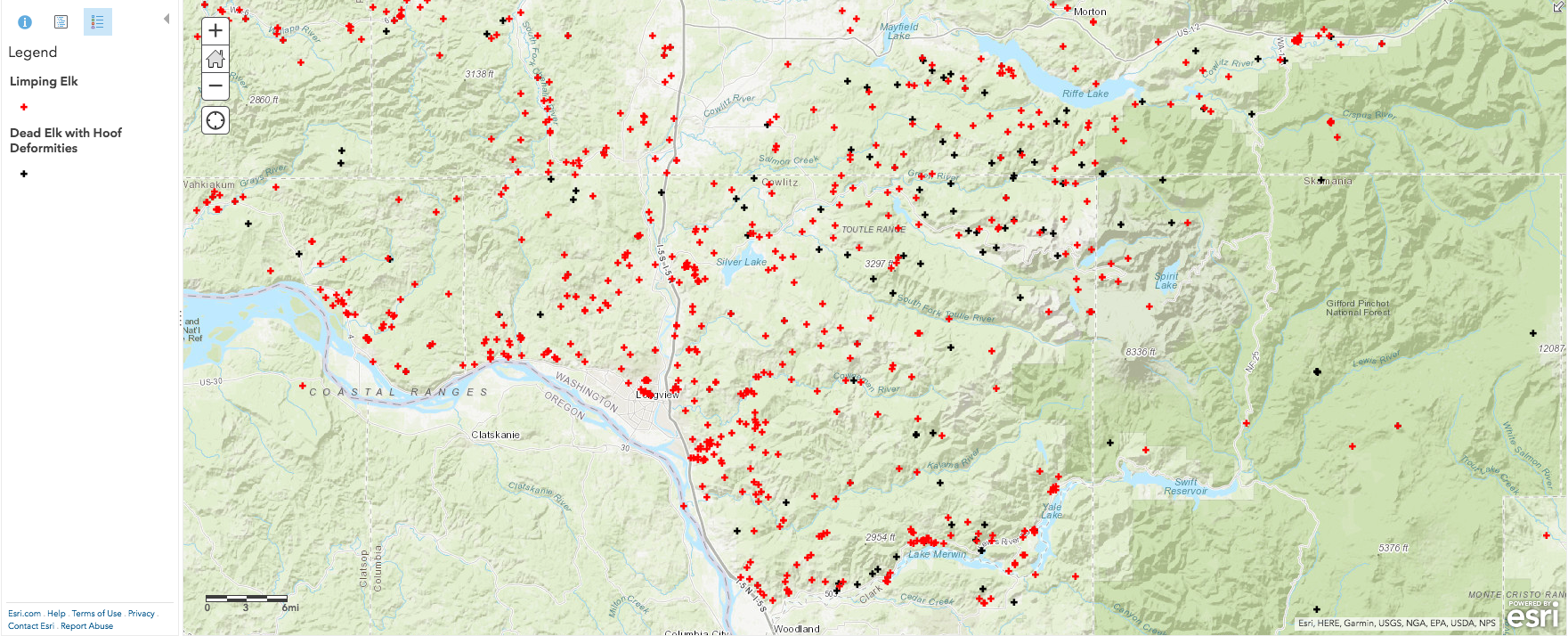
Elk hoof disease showed up in southwestern Washington elk herds around 2000 and has been slowly progressing ever since. A dramatic rise in reports of limping elk in 2007 prompted a scientific investigation into what was causing the rapid spread. Symptoms include limping while walking and overgrown or broken hooves. It is also reported that bull elk have deformities of the opposite antler, depending on the timing of the hoof infection. Washington Department of Fish and Wildlife (WDFW) scientists still don’t understand what causes the disease or how it spreads. The bacteria they have found to be present is a Treponema variety which is causing damage to the affected hooves. However, the WDFW team claims that Treponema is not the root cause of the hoof disease.
“I also have a little bit of concern because the Treponema hypothesis still requires an initiating event…until you figure out what that triggering event was you’re not going to be able to really understand the disease,” said Dr. Fairbrother, an ecotoxicologist with Exponent Engineering and Scientific Consulting.
Governor Jay Inslee has called upon Washington State University (WSU) to monitor the elk and continue studying them. They are just waiting on the legislature to determine where the funding of the project will come from. Charlie Powell, the PR officer for WSU’s College of Veterinary Medicine, said that although they have done some analysis of samples from 2009-2013 they still cannot find the catalyst for what is causing the disease. Now hoof rot is showing up in Oregon elk as well, so it is a never-ending problem.
Gene Crocker of Washington, a 20 year veteran of Cowlitz County Game and Anglers claims it’s simple. “I found out that after Weyerhaeuser clear cuts an area, they spray it with herbicide,” Crocker said. “This kills broadleaf plants for 3-5 years.” He also claims that the scientists don’t know what they’re talking about. “They haven’t been here like I have for 78 years and seen how things have changed. Deer run around with hair loss, pigeons have disappeared completely. We have few grouse now. Honeybees have ceased to exist in the wild.”
Mark Smith, owner and builder of Eco Park resort near Mt. St Helens has also witnessed the decimation of the area’s elk and deer population. “Ninety percent of all the chemicals that Weyerhaeuser uses say ‘DON’T USE ON GRAZING LAND’,” Smith said…”Why do we allow forest land to be sprayed when deer and elk graze in these areas?”

Copyright
© Eastmans




